After an automatic car wash, attractive water beads may remain on the bodywork even after air drying. A manually applied treatment may initially look glossy, yet wiping marks become visible from another angle. For formulators, these observations show why beading, drying performance, and final surface appearance must be evaluated separately.
When moving from hair-conditioning applications to vehicle-surface care, the evaluation focus shifts to water runoff, residual water, and appearance after drying. This article discusses methods for assessing silicone quaternary ammonium compound candidates. The cited hydrophobic-surface study is used only to distinguish wetting behaviour from droplet mobility; it is not evidence of automotive drying performance for Q80/Q80T. [1]
An end-of-cycle rinse aid followed by forced-air drying operates under different conditions from a spray-on product wiped with a towel. How the ingredient reaches the surface, its contact time, and how residues are removed can all influence the evaluation outcome.
|
Application method |
Primary evaluation objective |
Test conditions to hold constant |
|
Final rinse in an automatic car wash |
Water runoff and residual water under defined air-drying conditions |
Actual dilution ratio, spray volume, airflow or equipment settings, conveyor speed |
|
Manual spray-and-wipe treatment |
Spreading, ease of wipe-off, and uniform appearance |
Dose per unit area, towel type, number of wiping passes, waiting time |
|
Combined wash-and-care formulation |
Balance between cleaning and surface-care performance |
Cleaning system, soil load, extent of rinsing, final surface condition |
Select one primary application process at the start of development. Only after reproducible performance has been established in that process should extension to other application methods be considered.
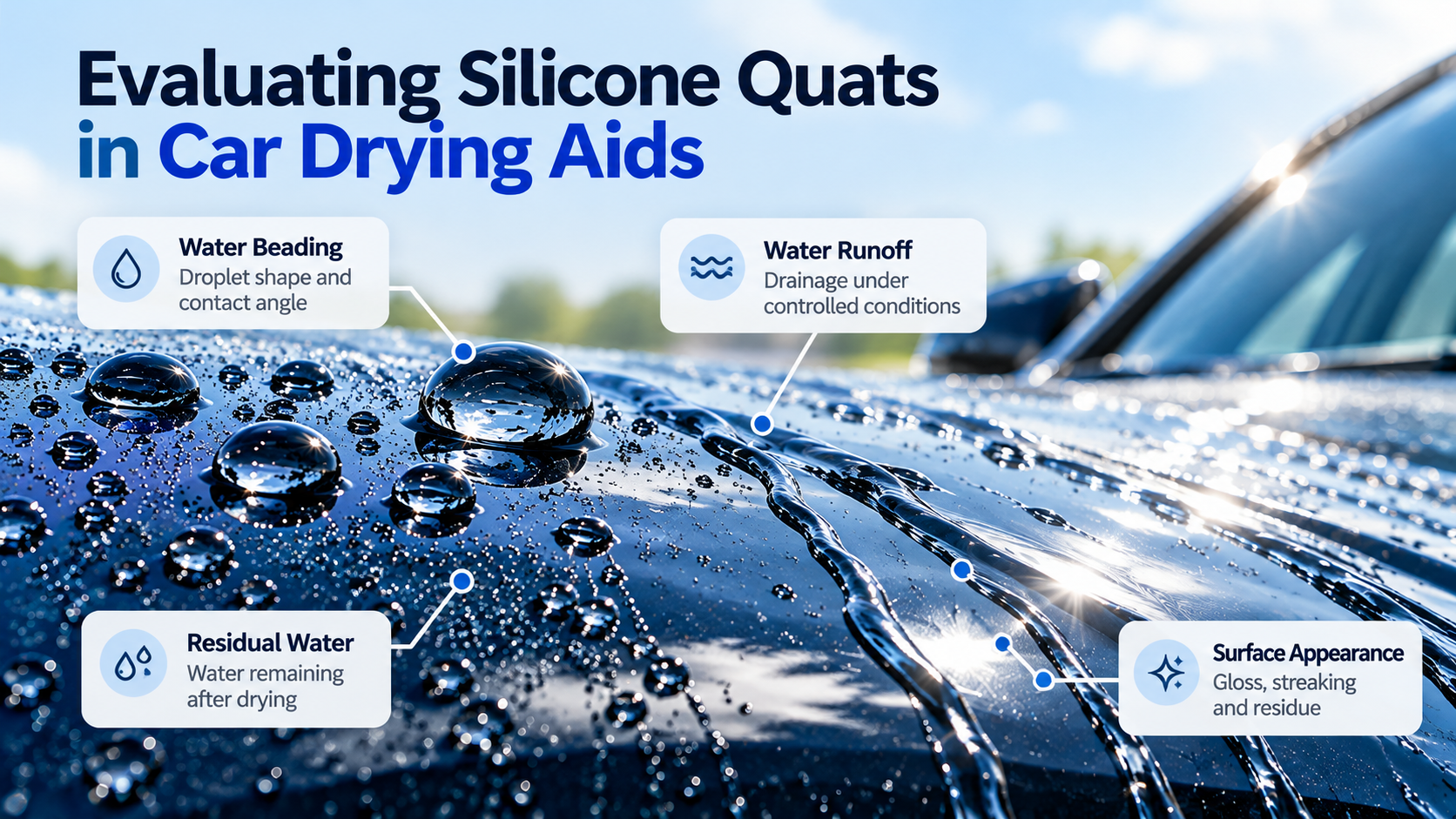
Contact angle describes the wetting behaviour of a droplet on a test surface. Whether that droplet can move or detach also depends on surface inclination, applied forces, and surface condition. Photographs of beading can illustrate a before-and-after effect, but cannot by themselves establish how much water remains after forced-air drying.
For drying-aid formulations, distinguish at least three questions: how water is distributed on the surface, how quickly it leaves, and what remains after drying. Contact angle, runoff behaviour, and water-spot assessment provide different information. Hydrophobic-surface research likewise measures contact angle and sliding angle separately rather than using one parameter to represent overall drainage performance. [1]
Use consistent panel inclination, spray conditions, and drainage times to compare gravity-driven runoff first, then verify results under identical air-drying conditions. If contact angle or droplet-sliding behaviour is measured, standardise droplet volume and substrate pretreatment to make comparisons meaningful.
“Quick drying” should not automatically be interpreted as an ingredient increasing the evaporation rate of water. In a given car-wash process, runoff and residual water are often the first outcomes to assess. Any effect on evaporation requires a separate experiment designed to test that mechanism.
During formulation development, identify the function of each component before deciding what a candidate silicone quat must demonstrate. The following functional breakdown supports experimental design; it is not a ready-to-use formula and does not imply that every product needs all listed components.
|
Functional role |
Question to resolve |
Control strategy |
|
Surface-care or hydrophobic component |
Does the treated surface meet the target condition? |
Hold its dosage constant to isolate the contribution of the new candidate |
|
Emulsifier or dispersant |
Are the concentrate and working solution uniformly dispersed? |
Evaluate stability separately; do not treat improved compatibility as evidence of faster drying |
|
Carrier and processing aid |
Can the ingredient be incorporated and diluted as intended? |
Record carrier contribution and include a carrier blank if necessary |
|
Candidate silicone quat |
Does it improve defined runoff or appearance metrics? |
Test against the base formulation using a dosage series; retain residual-water and film-residue records |
One ingredient may influence several stages, but that does not mean it can perform every function independently. If a candidate improves dispersion without reducing residual water, evaluate it for the contribution actually demonstrated. Film-forming coatings reported in the literature should not be treated as equivalent to rinse-applied drying-aid formulations.
Commercial silicone quaternary ammonium materials differ in chemical structure, carrier, and blended composition. Some supplied products contain additional functional components; the runoff or gloss performance of the complete blend cannot be attributed solely to the designation “silicone quat.”
Before comparing candidates, confirm the full commercial supply form: active content and its measurement basis, carrier, whether the product is a blend, and dispersion behaviour at the intended use dilution. Recommended dosages for other commercial blends must not be transferred directly to Q80/Q80T.
For formulators screening Quaternium-80, published research may inform the evaluation plan, but suitability of a particular grade must be established through tests in the target formulation and on the target substrate. Performance in personal-care formulations cannot be extrapolated directly to automotive-care applications.
At the concentrate stage, first verify that the candidate can be incorporated using the intended process and that appearance and flow properties remain stable. Next, prepare the working solution at the actual use dilution and monitor mixing uniformity, precipitation, phase separation, and foaming.
Where the formula contains anionic surfactants, waxes, or other care ingredients, assess compatibility in the complete system. Good dispersion in pure water does not mean the material can be added directly to every car-wash detergent or microemulsion. Record order of addition and dilution procedure as controlled test conditions rather than changing them between samples.
Water quality must also be included in the test plan. Deionised water helps minimise variables during initial screening; tap water or site-prepared water is needed to establish real-use relevance. If water-spot reduction is a target, record water quality alongside residual deposits; otherwise, mineral deposits from the water may be confused with marks from the care film.
Initial substrate testing should focus on the target automotive paint or clear-coat test panels. Glass, plastics, and other materials require separate evaluation criteria; a gloss result on painted panels does not establish suitability on other substrates. Windshields, footboards, and other areas where visibility or friction matters require separate clarity, wipeability, or friction testing. This article does not identify them as confirmed applications.
Screening an ingredient for rinse-on or wipe-on applications? Specify the target substrate and application process when requesting Q80 candidate information, so that supply form and compatibility conditions can be reviewed first.
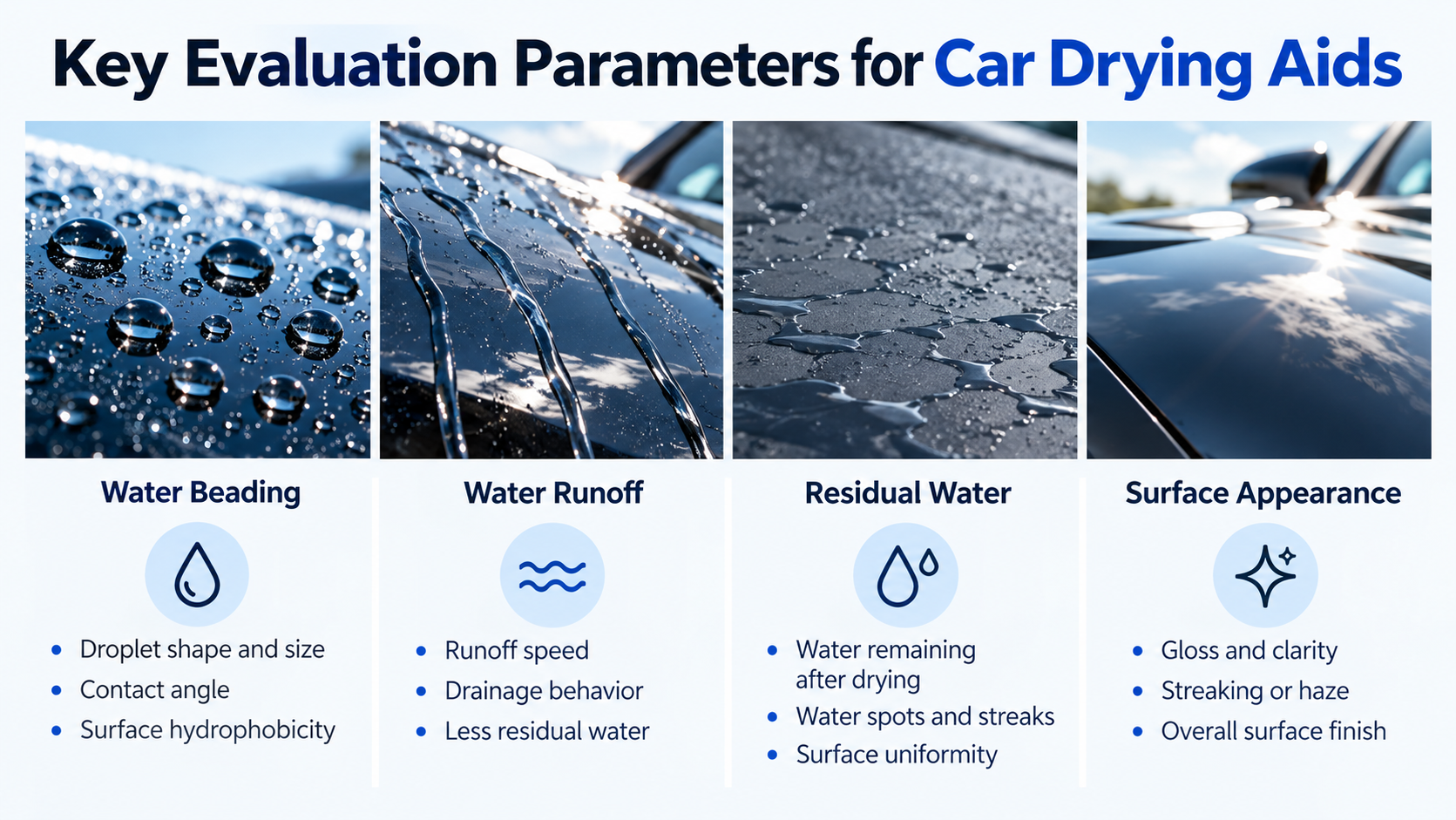
Use separate panels of the same type, cleaned and pretreated consistently. Include a base formulation without the candidate, the current reference formulation, and the candidate formulation. Document existing coatings and treatment history so that residual protective films do not dominate the results.
Keep application amount per unit area, contact time, rinse-water volume, and drying conditions identical across groups. During initial screening, use a dosage series to identify a workable range; then compare the minimum effective commercial-product dose needed to meet the same target.
|
Evaluation stage |
Recommended records |
How to interpret the result |
|
Water runoff |
Images at defined time points, drainage time, and residual-water distribution |
Determine whether the change occurs during runoff rather than only in droplet shape |
|
Air drying or towel drying |
Residual water under identical equipment conditions, or wiping passes to a defined endpoint |
Relate laboratory observations to the actual application process |
|
Appearance after drying |
Gloss, haze, streaking, and water spots |
Specify illumination and viewing angle; dark panels may provide a more sensitive visual check |
|
After repeated treatments |
Film uniformity, ease of wiping, and appearance changes |
Check whether a one-time benefit persists with repeated use |
If gravimetric analysis is used to compare residual water, use a dry panel in the same treatment state as the mass reference, and check whether deposited care material affects the reading. Record gravimetric, image-based, and visual assessment methods separately. Uncalibrated photographs must not be converted directly into a “percentage faster drying” claim.
A glossmeter can provide an additional objective comparison, provided the measurement geometry and substrate condition are consistent. Where only photographs are available, report the viewing conditions accurately rather than presenting visual observations as instrumental measurements.
The following scenarios are troubleshooting prompts, not evidence that any observation has a single cause.
|
Observation |
First factors to check |
Decision criterion |
|
Strong beading but substantial water remains after air drying |
Droplet mobility, air-drying conditions, and dosage |
Prioritise final residual water; attractive beading alone is not a pass |
|
Higher gloss accompanied by streaks or haze |
Dose per unit area, distribution uniformity, and wiping procedure |
Reduce or optimise dosage, then reassess gloss and clarity together |
|
Stable concentrate but unstable working solution |
Dilution water, dilution sequence, and local high concentrations |
Restore reproducible stability at use dilution before assessing performance |
|
Good initial appearance but more marks after repeated use |
Care-film residue, extent of cleaning/removal, and repeat-treatment procedure |
Include repeat-use performance among formulation acceptance criteria |
If progressively higher dosages produce only short-lived visual improvements while wiping and residue problems worsen, reconsider the ingredient or formulation strategy. Increasing the dose does not necessarily resolve a mismatch with the application process.
Raw-material purchase price, finished-product concentration, and actual use dilution together determine the cost per treatment. For automatic car washes, convert consumption to product used per vehicle wherever possible. For laboratory panels, compare treatment amount per unit area initially.
Price comparisons are meaningful only when runoff, appearance, and process requirements are equivalent. If one option requires equipment changes, additional wiping, or shorter maintenance intervals, those requirements should be included in the project evaluation.
Beading reflects the state of water on a surface. A drying-performance assessment must also control rinsing, gravity drainage, and air-drying conditions and compare final residual water or time to a defined endpoint. Keep beading photographs and measured residual-water records separately.
First compare chemical identity, the basis used to report active content, carrier, and whether the product is blended. Establish a separate dose–response relationship for each material, then compare commercial-product dosage at equivalent runoff and appearance targets.
Different substrates have different appearance and use requirements and must be verified separately. For glass, assess clarity, streaking, and application-relevant performance. The painted-panel evaluation framework in this article is not proof that other substrates have passed testing.
[1] Kumar et al., “Hydrophobic sol–gel coatings based on polydimethylsiloxane for self-cleaning applications,” Materials & Design, 2015. This study is cited to distinguish wetting behaviour from droplet mobility; the coatings investigated are not equivalent to silicone quats or Q80. DOI: 10.1016/j.matdes.2015.07.174.
Cosmecrafts welcomes enquiries about automotive-care ingredient evaluation. Please specify the target substrate, rinsing or wiping process, and your primary objective regarding runoff, residual water, or appearance. We can discuss current technical information and sample arrangements for Q80/Q80T; automotive suitability and dosage for each grade must be established through testing in the target formulation and on the intended substrate.
Discuss Automotive Care Ingredient Evaluation
Alternatively, email donna@cosmecrafts.com.